Start here
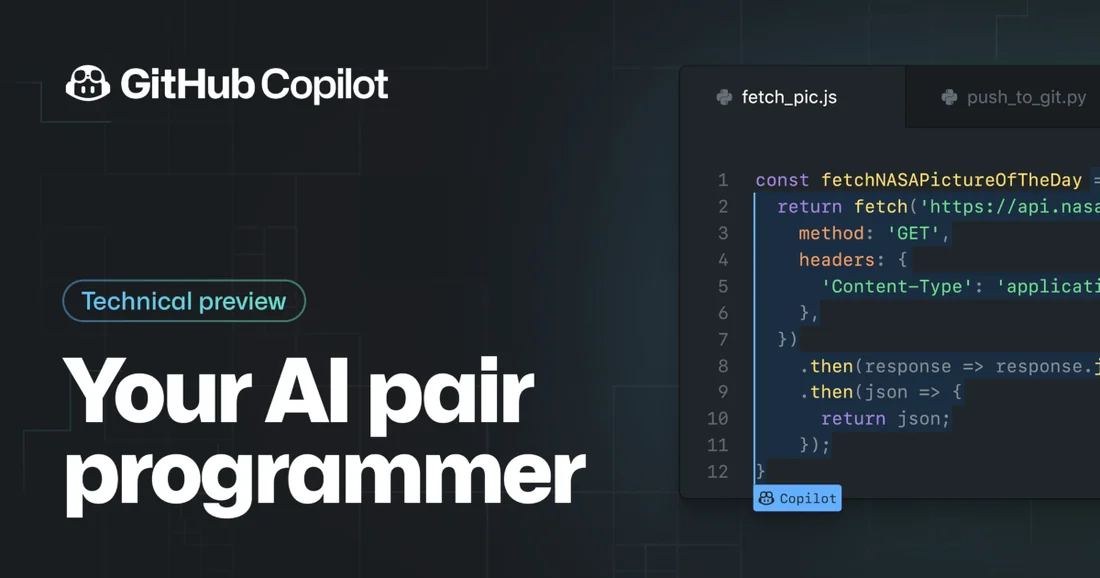
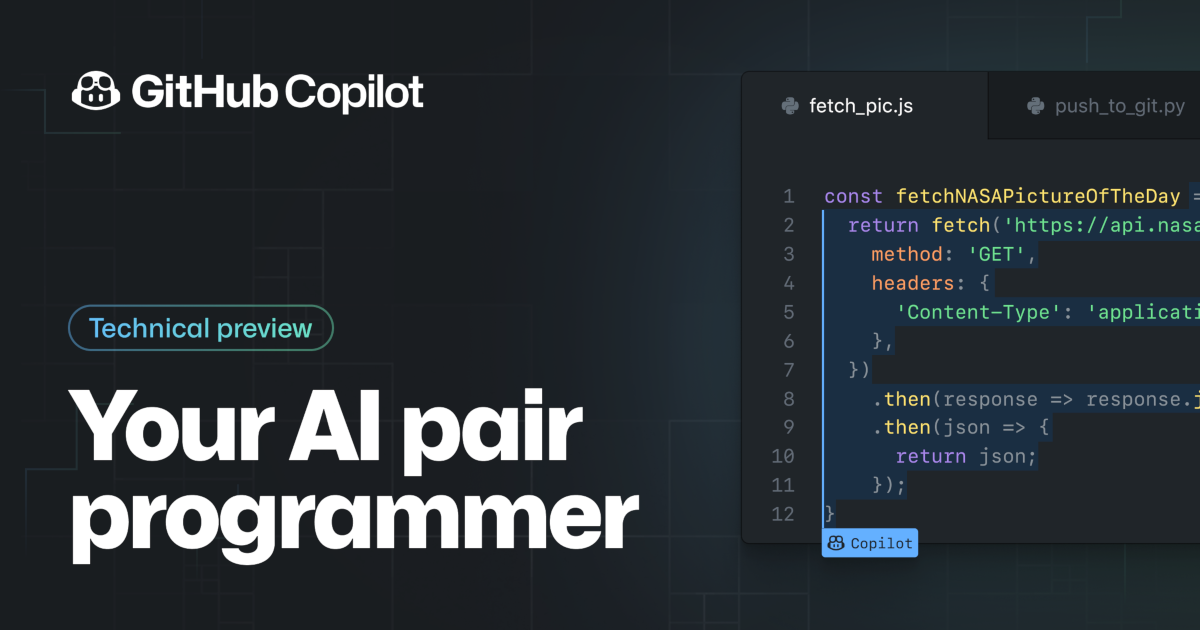
Before a chat window was pitched as a colleague you could ask anything, a narrower version of the idea shipped inside a code editor and found its first mass audience there. On 29 June 2021, GitHub's post Introducing GitHub Copilot: your AI pair programmer described a tool 'developed in collaboration with OpenAI' and 'powered by OpenAI Codex' that suggests 'whole lines or entire functions' as a developer types. Programmers became the first large group of everyday users of text generation partly because their work has something most writing tasks lack: a fast, cheap way to check whether the output is right. Code either compiles and passes a test, or it does not.
What the documents say
The 2021 post says Copilot 'works especially well for Python, JavaScript, TypeScript, Ruby and Go' and launched as a technical preview with limited, waitlist signup. A year later, GitHub Copilot is generally available to all developers, dated 21 June 2022, set a price of '$10 USD/month or $100 USD/year,' remaining free for 'verified students and maintainers of popular open source projects.' The same post reports, as GitHub's own figure rather than an independent audit, that among the 1.2 million developers who used the preview over the prior year, 'nearly 40% of code is being written by GitHub Copilot' in popular languages -- a vendor-stated adoption number describing usage volume, not a claim that the code was correct.
Check this
The check that carries beyond programming: ask whether the task has an equivalent to 'compile and run.' A suggested function can be tested immediately; a suggested paragraph of prose or a summarized legal clause usually cannot be checked as fast or as cheaply. Before trusting a generated answer elsewhere the way a developer might trust a suggested line of code, look for what your own quick, reliable check would be, and whether one exists at all.
What holds and what fails
This is an editorial reading of why coding became the first mainstream use case, not a claim either document makes directly: generation is easiest to adopt at scale where verification is fast, cheap, and does not require trusting the tool itself, which is exactly the position a compiler or test suite puts a developer in. The lesson fails to transfer whenever a task lacks that kind of check -- most everyday writing, research, or advice does -- and a confident-sounding answer there carries the same risk of being wrong as any other generated text, without code's built-in referee.
- Before trusting a generated answer, ask what your fastest, cheapest way to check it would be.
- If there is no equivalent to 'run the code,' treat the output as a draft that needs a second, independent check.
- Note whether a tool's stated adoption numbers describe usage volume or measured accuracy -- they are not the same claim.
Copilot's early growth is a record of what happens when generated text lands in a field with a built-in test; most of what people ask an assistant to do has no such test, which is exactly why the same trust cannot simply carry over.
Sources & reading trail
States what Copilot is built on, which languages it favors, and the technical-preview waitlist access model.
Source published: 29 June 2021 · Retrieved: 16 September 2026
States general-availability pricing, free access for students and maintainers, and GitHub's own reported adoption figure.
Source published: 21 June 2022 · Retrieved: 16 September 2026
Documentation, regulator guidance and studies establish the record; the checks and the boundary are AI Use Field Guide editorial analysis. This retrospective draft does not imply the site published on the event date.