Start here
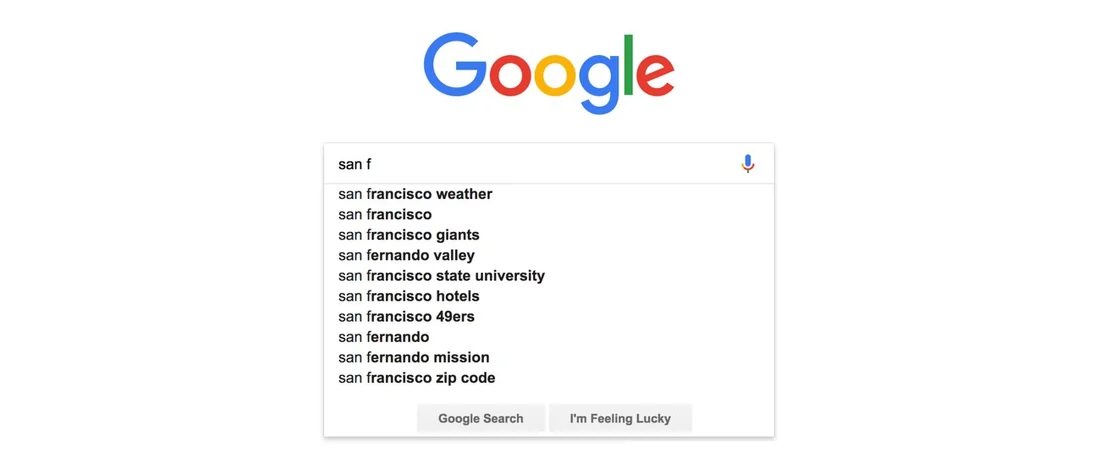
Before an assistant could write a paragraph, a search box learned to finish your sentence. Google's autocomplete -- the dropdown of guesses under the search box -- is an older, narrower kind of prediction than the generated answers common now, and Google's own documentation still describes it narrowly. The company's explainer on how autocomplete works says the feature offers 'predictions,' not 'suggestions': it guesses the search you already intend to type, not a new one to consider. That distinction matters for every predictive box that followed it, since it separates a shortcut for your own intent from a system proposing something of its own.
What the documents say
Google states predictions are drawn from 'real searches that happen on Google' and reflect what is 'common and trending,' adjusted for the characters typed, general location, and, when personalization is on, a signed-in user's own history. The company also states an efficiency figure -- autocomplete 'reduces typing by about 25 percent' -- which is Google's own measurement, not an independently audited one, and should be read as a vendor's claim. On moderation, the explainer lists policies removing predictions that are sexually explicit outside medical or educational contexts, hateful, or tied to violent acts, later expanded to cover predictions 'reasonably perceived as hateful or prejudiced.' The current Autocomplete predictions support page, retrieved 16 September 2026, adds the user-facing side: predictions can draw on past searches when personalization is on, and a prediction believed to violate policy can be reported from the search box.
Check this
Two checks follow. First, sign out or turn off search personalization and see whether the same partial query produces different completions -- the gap shows how much of the guess is about you specifically rather than what most people type. Second, treat a prediction as a popularity signal, not a fact or endorsement: the explainer says the goal is matching an intended search, so a strange completion reflects search volume and pattern-matching, not a claim Google is making about the world.
What holds and what fails
This is an editorial reading, not stated by the documents: autocomplete holds up as a narrow, checkable mechanism -- a shortlist drawn from real query patterns -- for as long as a user reads it that way. It fails the moment someone treats a completion as an authoritative claim, since the source material never promises accuracy, only pattern-matching within stated policies. The value of this older feature is that it separates two things people now blur: predicting the next few words of a request, and generating an answer to it.
- Turn off search personalization once and compare autocomplete results for the same partial query.
- Read Google's own autocomplete policies before assuming a strange prediction reflects a company judgment rather than search volume.
- Use the in-box reporting option if a prediction looks like it violates the stated policy, rather than assuming it will self-correct.
Predictive text in a search box was never meant to answer a question, only to save keystrokes; keeping that boundary in mind is useful before trusting text a newer tool generates in full.
Sources & reading trail
States how autocomplete predictions are generated, the predictions-versus-suggestions distinction, and content policies.
Source published: 20 April 2018 · Retrieved: 16 September 2026
Current living documentation on personalization and reporting a policy-violating prediction.
Source published: Not established · Retrieved: 16 September 2026
Documentation, regulator guidance and studies establish the record; the checks and the boundary are AI Use Field Guide editorial analysis. This retrospective draft does not imply the site published on the event date.