Start here
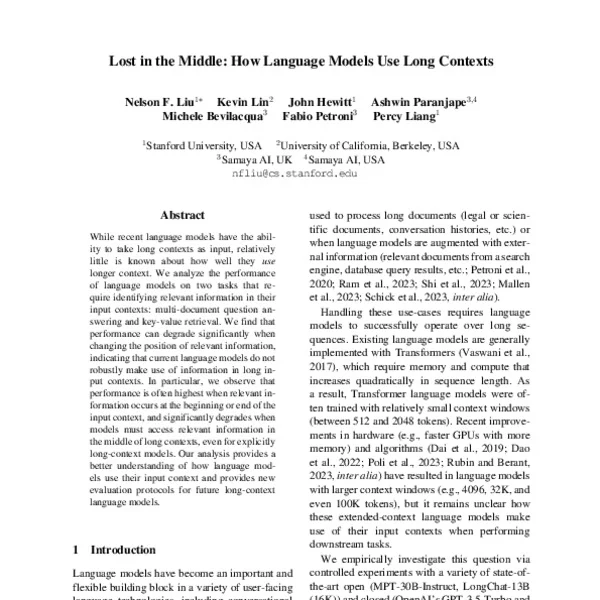
Anyone pasting a long document into an assistant and asking about something buried on page six is relying on a capability the source research found to be uneven. Lost in the Middle: How Language Models Use Long Contexts, submitted 6 July 2023 by Nelson Liu and six co-authors, tested whether language models actually use everything inside a long input the way a reader would assume, or whether where a fact sits changes whether the model finds it.
What the documents say
The paper's method was two tasks built to isolate position from content: multi-document question answering, where one relevant document was placed among several distractors at different positions in the input, and key-value retrieval, a simpler synthetic task with the same positional test. Its own abstract states the result plainly: performance is often highest when relevant information occurs at the beginning or end of the input context, and significantly degrades when models must access relevant information in the middle of long contexts, even for explicitly long-context models. That last clause matters: a model marketed for handling long inputs was not exempt from the pattern. The paper was later published as a peer-reviewed article in Transactions of the Association for Computational Linguistics, volume 12, pages 157 to 173, in 2024, evidence the finding held up under review rather than only as a preprint. The paper's own conclusion is a limit on the systems it tested, not every future model.
Check this
The mechanism a reader can check without any special tools: take a long document already in use with an assistant, move the one fact the question depends on from the middle to the very start or end, and ask the same question again. If the answer changes, position was doing some of the work that the length of the context window gets credited for. This mirrors exactly the manipulation the paper itself used.
What holds and what fails
The finding holds as a documented limit on the tested systems at the time of the study: a U-shaped curve where the middle of a long input is the least reliably used part. It does not establish that every model, including ones released later, shows the identical curve, and the paper does not claim that. Treating 'can take a long document' as equivalent to 'weighs every part of it equally' is the overreach this research pushes back on, an editorial line drawn from the study's own stated result.
- Put the single most important fact or instruction at the very start or end of a long prompt, not buried in the middle.
- For a long document, ask a narrow question about a middle section as a test before trusting a broader summary.
- Treat a large advertised context window as a capacity limit, not a guarantee every part of it is used evenly.
A longer context window answers how much can be included, not how well each part is used, and this study is the source for keeping those two questions separate.
Sources & reading trail
States the two tasks (multi-document QA, key-value retrieval) and the U-shaped position-accuracy finding, including for long-context models.
Source published: 6 July 2023 · Retrieved: 16 September 2026
Confirms the peer-reviewed TACL publication (volume 12, pages 157-173, 2024) of the same study.
Source published: Not established · Retrieved: 16 September 2026
Documentation, regulator guidance and studies establish the record; the checks and the boundary are AI Use Field Guide editorial analysis. This retrospective draft does not imply the site published on the event date.