Start here
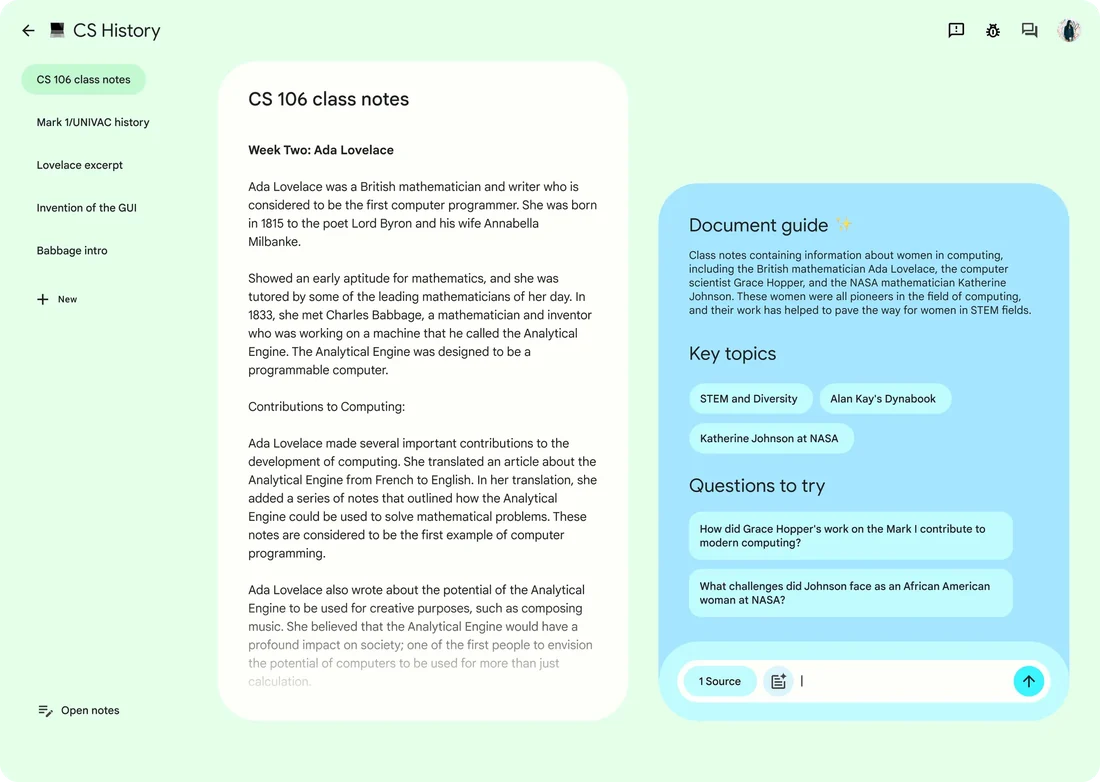
A reader who has been burned by an assistant inventing a plausible-sounding but wrong fact is asking, without necessarily naming it, for a narrower kind of tool: one that answers only from documents the reader chose, and says so when the answer isn't in them. Google built exactly that distinction into NotebookLM, now called Gemini Notebook in the product's current documentation, and the difference from a general chatbot is a design choice worth naming precisely rather than assuming.
What the documents say
Google's launch post 'Introducing NotebookLM', dated 12 July 2023, describes letting a user 'ground the language model in your notes and sources,' stating that 'the model only has access to the source material that you've chosen to upload, and your files and dialogue with the AI are not visible to other users.' Google's current help page 'Learn about Gemini Notebook', retrieved 16 September 2026, restates the same restriction in the product's present form: it is 'designed to answer questions based on the information provided in your uploaded sources,' while warning that the tool 'can make mistakes and its answers don't reflect Google's views.' A separate FAQ page states a concrete technical limit: 'the current limit is 500,000 words per source or up to 200MB for local uploads,' with copy-protected PDFs and oversized files rejected outright, and describes a case labelled 'information not in sources' where the tool declines rather than answers from general knowledge.
Check this
The direct check is to ask the tool a question whose answer is not contained in any uploaded source, and see whether it declines rather than guesses; Google's own pages describe this decline as intended behaviour, not a failure. A second check is source size: a very long document uploaded whole may exceed the stated word or file-size limit and fail to import, which the FAQ names as an explicit boundary rather than a vague slowdown.
What holds and what fails
Restricting answers to uploaded sources genuinely reduces one specific failure mode — invention from general training data when a reader wanted a specific document summarized — and Google's own pages describe this as the tool's defining behaviour rather than a marketing claim. It does not remove the possibility of a wrong reading of a real source, which the mistake-disclaimer covers, and it does not extend past the sources a user actually adds. This is a narrower, more checkable tool than a general assistant, not an infallible one.
- Add every source actually needed before asking a question, since the tool will not reach beyond what's uploaded.
- Test the tool with a question it cannot answer from the sources, to see the decline behaviour directly.
- Check a long document against the stated per-source limit before assuming it uploaded completely.
A grounded notebook trades the breadth of a general assistant for a narrower, more checkable promise: it can still be wrong about a source, but it is not meant to answer from outside the sources at all.
Sources & reading trail
Announces NotebookLM's initial rollout and states that the model only accesses sources a user chooses to upload.
Source published: 12 July 2023 · Retrieved: 16 September 2026
States that the tool answers only from uploaded sources and can make mistakes.
Source published: Not established · Retrieved: 16 September 2026
States the concrete per-source limit of 500,000 words or 200MB for uploads and the 'information not in sources' decline case.
Source published: Not established · Retrieved: 16 September 2026
Documentation, regulator guidance and studies establish the record; the checks and the boundary are AI Use Field Guide editorial analysis. This retrospective draft does not imply the site published on the event date.