Start here
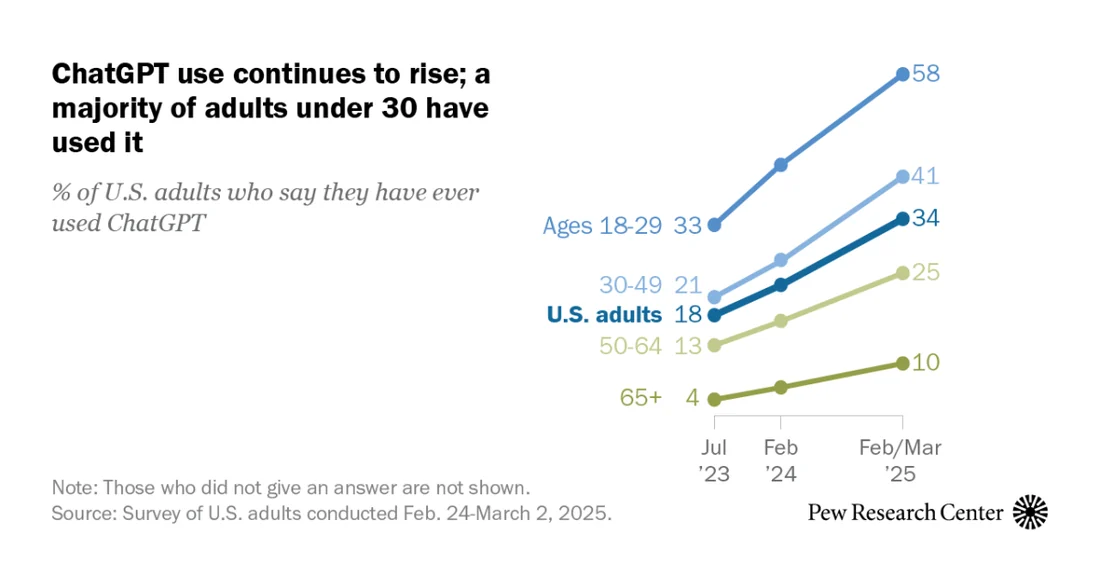
Someone trying to judge how mainstream chatbot use has become cannot rely on a single anecdote or a vendor's user count, which mixes casual visitors with regular users. A tracked public survey gives a steadier read. The Pew Research Center reported that 34 percent of US adults said they had used ChatGPT, based on a survey fielded February 24 to March 2, 2025.
What the documents say
This is a survey, not a usage log: Pew asked a nationally representative sample to self-report whether they had ever used ChatGPT, drawing on the American Trends Panel, a probability-based panel of roughly 10,000 US adults recruited by random sampling rather than by opt-in, with this particular survey drawing a subsample of 5,123 respondents. The report's own title states the 34 percent figure is about double the share Pew measured in 2023. Reported use varies sharply by age: Pew's release states that among adults under 30, reported ChatGPT use rose from 33 percent in 2023 to 43 percent in 2024 and 58 percent by 2025, a faster climb than the overall population. Reported reasons for use also shifted: work-related use rose from 8 percent to 28 percent of adults and learning-related use from 8 percent to 26 percent between the two survey waves, per the same report.
Check this
A reader can check any 'X percent of people use AI' claim by asking whether it comes from a probability-based panel, where a scientifically drawn sample stands in for the population, or an open online poll that mainly hears from people already inclined to answer. The American Trends Panel's methodology page states panelists are selected at random rather than volunteering, which is the mechanism that makes a claim like '34 percent' defensible as more than the loudest respondents' opinion.
What holds and what fails
The trend the surveys establish, rising, self-reported awareness and use, growing fastest among younger adults, holds as a description of stated behavior at two points in time. It fails as a measure of depth or benefit: 'has used ChatGPT' does not distinguish someone who tried it once from someone using it daily for work, and self-reported use can run ahead of or behind actual use depending on how a respondent interprets the question. It is editorial, not Pew's own claim, to read a rising usage share as evidence that AI use is making people more productive or better informed; the survey measures reported use, not outcomes.
- Ask whether a usage statistic comes from a probability-based survey panel or an open online poll before trusting its size.
- Distinguish 'has ever used' from 'uses regularly' when a percentage is quoted to you.
- Compare age or demographic breakdowns, not just the topline number, when judging how a trend applies to you.
A rising usage share is a fact about behavior, not a verdict on whether that behavior is helping the people reporting it, and the two should not be collapsed into one headline.
Sources & reading trail
States the 34% figure, survey field dates and sample size, the age breakdown for under-30 adults across 2023-2025, and the work and learning use-share increases.
Source published: 25 June 2025 · Retrieved: 16 September 2026
States the panel is probability-based, recruited by random address-based sampling rather than opt-in, at roughly 10,000 members with subsamples drawn per survey.
Source published: Not established · Retrieved: 16 September 2026
Documentation, regulator guidance and studies establish the record; the checks and the boundary are AI Use Field Guide editorial analysis. This retrospective draft does not imply the site published on the event date.