Start here
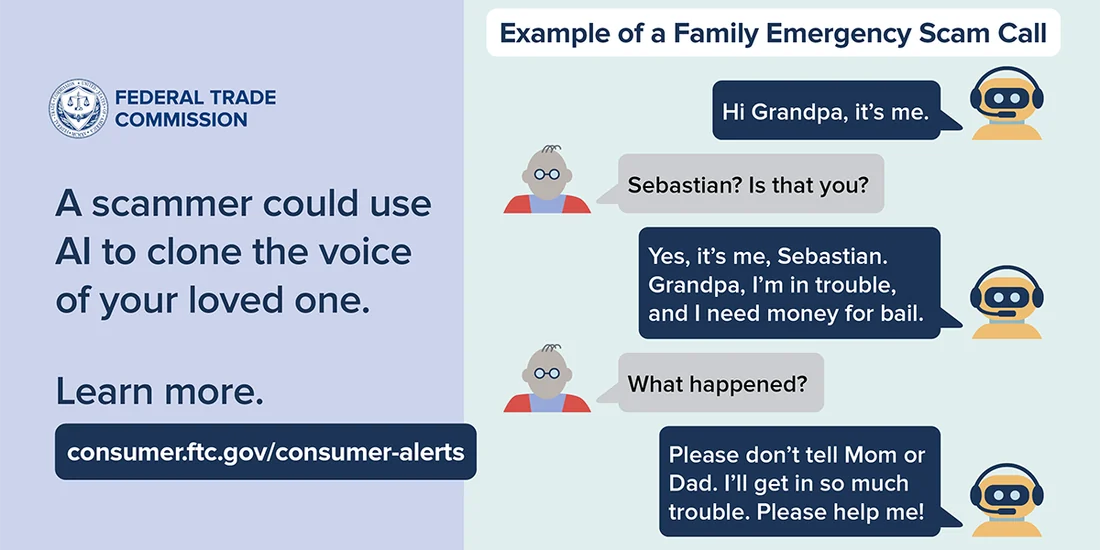
A phone call that sounds exactly like your grandchild, your parent, or your child is not proof that it is them. In March 2023 the Federal Trade Commission published a consumer alert stating that scammers use short clips of a person's voice, often pulled from content already online, to produce a cloned voice for a fabricated emergency call. The task is not technical: it is deciding, in the moment a distressed voice asks for money, whether to trust that sound or verify through a separate channel. The alert's answer is specific: verify, and do not skip that step because the voice sounds right.
What the documents say
The FTC alert, written by consumer education specialist Alvaro Puig, describes the scheme plainly: a caller claims a family member is in a car accident or legal trouble and needs money urgently, wired, sent in cryptocurrency, or paid in gift cards. Those payment types are the alert's own flag for fraud, since each is hard to reverse or trace. Its core instruction is to not trust the voice, and instead call the person back on a number already known to be theirs. A companion FCC consumer guide extends the warning to robocalls and text links: a caller ID showing a familiar or 'local' number does not confirm who is calling, since spoofing can forge that display. The two documents describe one failure from two directions: a live scam call, and spoofed numbers or deepfaked video links pushing counterfeit sites. Neither offers a measured rate of how often listeners are fooled; both are guidance, not a study.
Check this
The mechanism worth naming is call-back verification through an independent channel. If a call claims a relative is in distress, hang up and dial that relative's number from your own contacts, not one the caller provides. If the request involves a wire transfer, cryptocurrency, or a gift card, treat the payment method itself as the FTC's primary warning sign, regardless of how convincing the voice was. A household can also agree in advance on a question only a real family member would answer, though neither document specifies this; it extends the same principle editorially.
What holds and what fails
The verification habit holds regardless of how good voice cloning becomes, since it does not depend on detecting the fake but on using a channel the scammer does not control. It fails if someone skips the callback under time pressure, exactly the urgency the alert says scammers manufacture, or if the 'known number' dialed was itself supplied by the caller. This is a household precaution, not a technical fix, and says nothing about detecting a cloned voice in a recording afterward.
- Save the direct numbers of close family members now, before any emergency call arrives.
- Agree on a callback habit: any urgent money request gets a hang-up-and-call-back, every time.
- If a scam happens, report it at ReportFraud.ftc.gov, as the alert recommends.
Two regulators, one from consumer protection and one from communications, converge on the same point: a voice alone is not identity, and the fix is a habit, not a detector.
Sources & reading trail
States the voice-cloning family-emergency scheme and the FTC's verify-independently advice.
Source published: 20 March 2023 · Retrieved: 16 September 2026
Extends the warning to spoofed caller ID and AI deepfake video scam links, as a living consumer guide.
Source published: Not established · Retrieved: 16 September 2026
Documentation, regulator guidance and studies establish the record; the checks and the boundary are AI Use Field Guide editorial analysis. This retrospective draft does not imply the site published on the event date.