
Start here
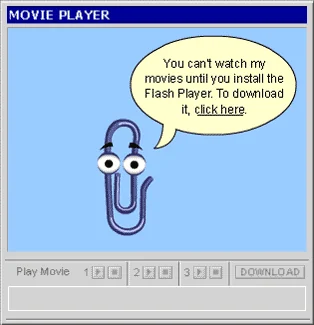
Anyone who has dismissed an app's pop-up suggestion three times in one sitting is living out a problem Microsoft itself admitted to in public. The Office Assistant, the animated character best remembered as Clippy, shipped as a default, on-screen helper that watched what a person typed and volunteered advice unasked. By 2001, as Office XP approached, Microsoft ran its own ad campaign in which the character conceded the point. On a page titled Microsoft Clippy, the company let the assistant speak in the first person: 'Office XP works so easily that it's made Office Assistants like me useless. Obsolete.' That is a vendor's own record of a default-on feature becoming the thing users wanted off.
What the documents say
The campaign page identifies the character by name -- 'I, Clippit, known to all as "Clippy"' -- voiced by comedian Gilbert Gottfried in self-mocking video shorts that make its own uselessness the joke. The page ties retirement directly to a product change: Office XP, it says, made constant on-screen prompting unnecessary. A separate Microsoft release from that spring, Microsoft Showcases Customer Solutions, Demonstrates New Office XP Technologies, dated April 9, 2001, covers the same release cycle in ordinary corporate language with no mention of the Assistant -- the retirement was marketing, not a technical bulletin, and together the two show a company managing a feature's exit through humor rather than a changelog.
Check this
The check that generalizes: when software offers help before you ask, find out whether that behavior is a default or a choice, and whether turning it off takes one click or three menus. Clippy's problem was never that suggestions existed; it was that the character appeared unasked, interrupted a task in progress, and was, by Microsoft's own account, disliked enough that the company later paid for a campaign apologizing for it. Any assistant that inserts itself into a document, inbox, or chat window is worth the same two questions.
What holds and what fails
This reading is editorial, drawn from what the documents show rather than stated in them: proactive help holds up when it is specific to the task at hand, easy to dismiss permanently, and something the user opted into. It fails when it is generic, default-on, and repeats regardless of whether the previous suggestion helped -- the exact complaint that made Clippy a joke Microsoft told about itself. The lesson is not that animated characters are bad; it is that an assistant's welcome depends on consent and relevance, not on how advanced its underlying model is.
- Check whether a new AI feature in your software is on by default, and note where the off switch lives.
- Read the actual 2001 campaign page to see a vendor's own account of why a default assistant failed: Microsoft Clippy.
- When a tool interrupts a task with a suggestion, note whether dismissing it once stops the behavior or only postpones it.
Clippy's afterlife as a punchline obscures a simpler fact worth keeping: the company that built it eventually agreed, in its own words, that unwanted help is not help at all.
Sources & reading trail
Microsoft's own self-parody campaign in which the Clippit character calls Office Assistants obsolete as Office XP launched.
Source published: Not established · Retrieved: 16 September 2026
Confirms the dated April 2001 Office XP announcement season referenced by the campaign page.
Source published: 9 April 2001 · Retrieved: 16 September 2026
Documentation, regulator guidance and studies establish the record; the checks and the boundary are AI Use Field Guide editorial analysis. This retrospective draft does not imply the site published on the event date.